How to hire a marketing agency from an Upwork job post
A buyer-side checklist for writing an Upwork brief that filters for diagnostic marketers instead of template responders.

Most Upwork marketing posts accidentally reward the wrong agency.
They ask for a channel specialist, list a budget, mention a few tools, and end with a broad request for examples. The replies arrive quickly, but they all sound the same: screenshots, promises, vague case studies, and a plan to start with an audit.
The problem is not Upwork. The problem is the brief.
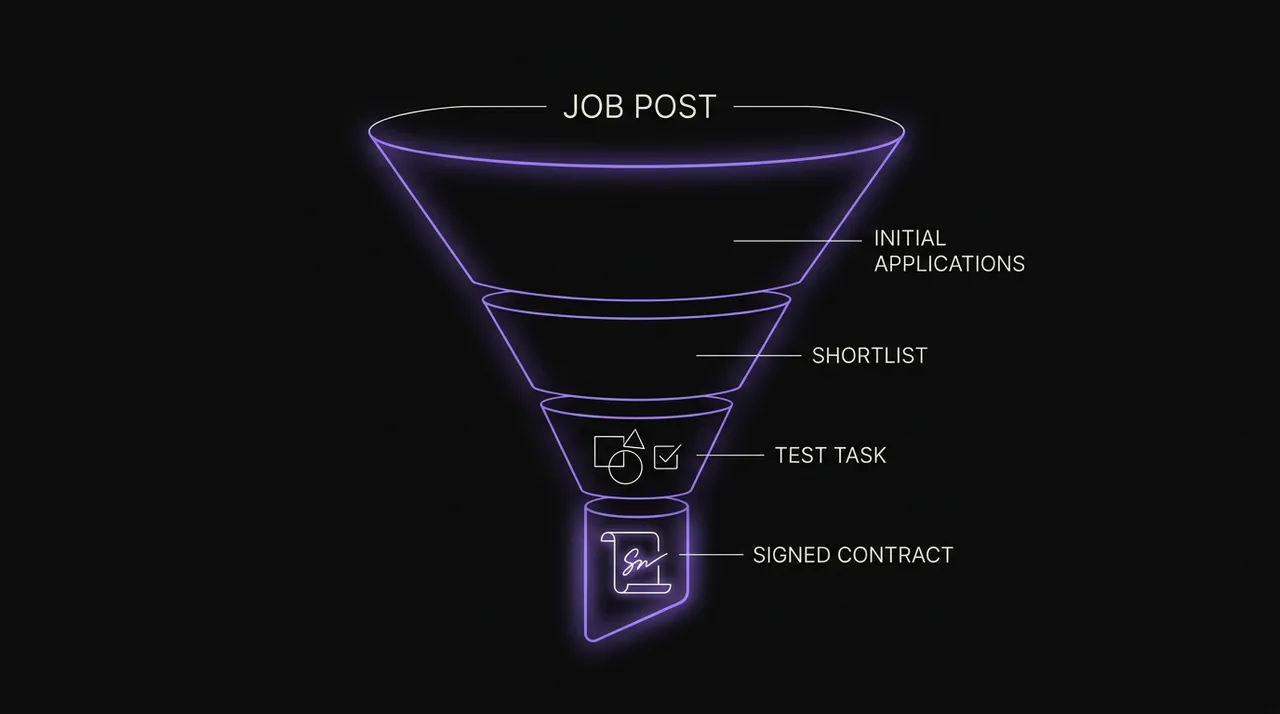
If your post does not force the agency to diagnose tradeoffs, you will get responses from people who are good at applying to jobs, not necessarily people who are good at fixing accounts.
What a useful brief includes
Write the post like you are hiring for judgment, not task completion.
| Include | Why it filters better |
|---|---|
| Current monthly spend | Agencies can size the account honestly. |
| Primary conversion event | It prevents vanity metric replies. |
| Average order value or deal size | It lets the bidder reason about CPA. |
| Main constraint | Budget, tracking, creative, sales cycle, or operations. |
| Recent symptom | Leads dropped, CPL rose, ROAS slipped, volume stalled. |
This does not mean sharing sensitive financials. Ranges are enough. The goal is to make the applicant reason from the economics of the business.
A strong agency reply should show how they think before it shows what they sell.
What to ask for
Do not ask for a generic proposal. Ask for a diagnosis.
Use prompts like:
- Based on this brief, what are the first three things you would inspect?
- What would make you advise us not to scale spend yet?
- Which number would you want before recommending a channel plan?
- What would you cut in the first week if the account looked inefficient?
These questions are hard to fake with a template. A weak responder will list services. A stronger one will talk about sequencing, risk, measurement, and what they would refuse to do.
Signals in the replies
Good replies usually have a few tells.
| Signal | What it means |
|---|---|
| They mention your economics | They read the brief and understand constraints. |
| They ask about tracking | They know platform data can lie. |
| They separate diagnosis from execution | They are not rushing to sell a package. |
| They name a kill rule | They know when to stop spending. |
Bad replies lean on broad promises. They say they can manage Google Ads, Meta, TikTok, SEO, email, and analytics without narrowing the first move. That sounds flexible, but it usually means the plan will be made after you pay.
A better post template
Here is a cleaner structure:
| Section | Prompt |
|---|---|
| Business | What we sell, who buys, where revenue comes from |
| Current state | Spend range, channels, conversion event, recent symptom |
| Constraint | The thing that makes this hard right now |
| Required response | Ask for first inspection steps and one likely kill rule |
| Proof | Ask for one relevant example, not a portfolio dump |
The proof request matters. If you sell high ticket B2B services, a screenshot from a low ticket e-commerce account may not mean much. If you need local lead quality, ask how they separate cheap leads from bookable ones.
Our own public notes cover this distinction in the only marketing metric that matters and the reporting scorecard. You are trying to hire someone who thinks in those terms before you give them access to spend.
The decision rule
Shortlist the agency that can explain what they would not do.
That is usually more valuable than a long list of tactics. Anyone can say they will optimize campaigns. A useful operator can tell you what would make them pause, cut, restructure, or decline a channel altogether.
That is the posture you want in your account.
Need a second read on an agency proposal before you hire? Book a free audit call. We will help you separate a real diagnosis from a polished template. Before you post, read our breakdown of what an ad agency actually does today so you know exactly what to ask for.