Real Estate Marketing Agency: What Actually Fills Showings
Most agencies optimize for leads. Showings are what close deals. Here's the gap and how to fix it.

Most real estate marketing agencies will show you a dashboard full of leads and call it a win. Form fills. Phone calls. Maybe a cost per lead that looks reasonable on paper. Then you ask how many of those leads became showings, and the conversation gets quiet.
We run paid ads for real estate and property management clients. The pattern we see on day one is always the same. The account is optimized for a conversion event that has almost no correlation with revenue. The agency reports on it anyway because it makes their numbers look good.
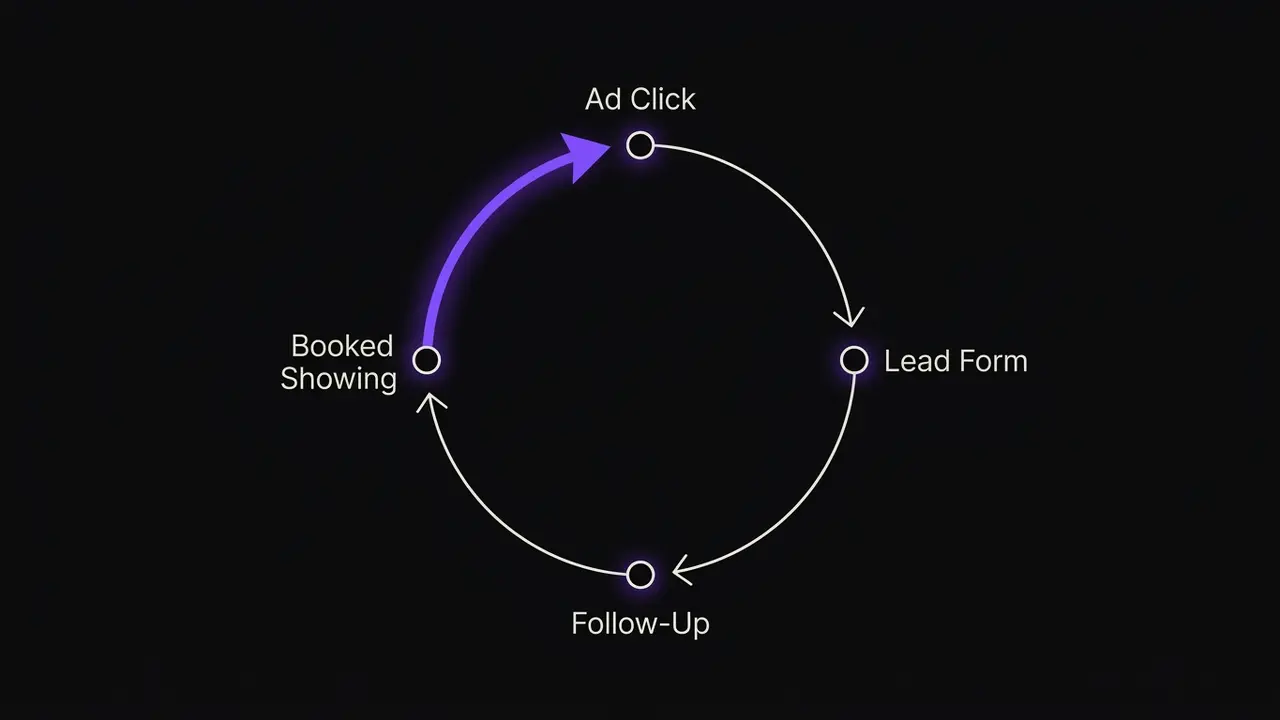
The honest answer to "what does a real estate marketing agency actually do that matters" is this. The only metric that fills showings is a closed loop between ad click and booked appointment. Everything else is decoration.
Why do most real estate ad accounts optimize for the wrong event?
Because form fills are easy to track and showings are not.
A lead form on a landing page fires a conversion event the moment someone hits submit. Google Ads and Meta both see it instantly. The algorithm has clean signal. The agency can point at a number and say "here's your cost per lead, it went down 12% this month."
But here is what happens between that form fill and a showing. The lead sits in a CRM for six hours. Someone calls and gets voicemail. The lead was actually just curious about pricing in a neighbourhood they will never buy in. The lead double submitted because the page loaded slowly. None of that shows up in the ad platform.
So the algorithm keeps optimizing for more of the same. More form fills. More curiosity clicks. More budget spent on people who will never sit in a buyer's seat or walk through a listing.
We built custom closed-loop attribution for a real estate client, RentCorp, that tracks from ad click all the way to booked showing. The difference between what the ad platform reported as "conversions" and what actually became showings was not small. It was the difference between a dashboard that looks healthy and a pipeline that is actually full.
What does a real estate agency marketing plan need to track?
If you are evaluating a digital marketing agency for real estate, or building your own real estate agency marketing plan, here is the minimum measurement stack that matters.
| Metric | What it tells you | Why agencies skip it |
|---|---|---|
| Cost per lead | How cheap the top of funnel is | They don't skip this one. It's the only thing most track. |
| Lead to showing rate | Whether leads are actually qualified | Requires CRM integration most agencies won't build |
| Cost per showing | Your true acquisition cost for revenue-generating activity | Needs closed-loop attribution between ad platform and booking system |
| Showing to close rate | Whether the product and the agent are doing their job | Outside the agency's control, but they should still ask about it |
The third row is where the real work lives. Cost per showing is the number that tells you whether your ad spend is actually producing revenue or just producing activity.
Diagnostic question: Can your current agency tell you, right now, what it costs to produce one booked showing from a specific campaign? If the answer is no, you are paying for a report, not for results.
This is not a theoretical framework. Across our client base, the average account has 15 to 30% wasted budget on day one. In real estate specifically, that waste concentrates in campaigns that generate cheap leads nobody ever follows up on, or leads that were never qualified to begin with. The algorithm learned to find more of them because the conversion event told it to.
How do you actually build the closed loop?
Three pieces need to connect.
1. The booking event must fire back to the ad platform.
If showings are booked through a calendar tool, a CRM, or even a manual entry by an admin, that event needs to send a signal back to Google Ads or Meta as a conversion. This is not a native integration in most real estate CRMs. It requires custom work. We built exactly this for RentCorp, connecting ad click to booked showing so the algorithm could optimize toward the event that actually matters.
2. Speed to lead must be measured alongside ad performance.
A lead that sits for four hours is a different lead than one contacted in four minutes. If your agency is not asking about your response time, they are optimizing a system with a leak they refuse to acknowledge. The best ad campaign in the world cannot fill showings if nobody picks up the phone.
3. Campaign structure should separate intent levels.
A person searching "condos for sale in Mississauga" is not the same as someone who clicked a Facebook ad about "5 things to know before buying your first home." These need different campaigns, different landing pages, and different expectations for showing rate. Lumping them together is how you get an average cost per lead that looks fine but hides the fact that one campaign is producing showings and the other is producing noise.
For a real estate marketing agency in Toronto or anywhere in the GTA, this structure matters even more because competition is dense. You are bidding against every other agent and brokerage in the same postal codes. Wasting budget on unqualified clicks is not just inefficient. It is actively funding your competitors' impression share.
What should you look for when hiring a real estate agent marketing agency?
Forget the listicles. The "best real estate marketing agency" posts you find in search results are almost always paid placements or affiliate content. They tell you nothing about whether an agency can actually fill your calendar.
Here is what to ask instead.
Do they build attribution or just report on platform metrics? If the answer is "we give you a monthly report from Google Ads," that is not attribution. That is a screenshot with a logo on it.
Do they require access to your CRM or booking system? If they do not want that access, they cannot optimize toward showings. They will optimize toward whatever is easiest to measure, which is almost never the thing that makes you money.
What is their pricing model? Real estate marketing agencies that charge hourly or per deliverable have no incentive to reduce your cost per showing. They get paid the same whether your calendar is full or empty. Retainer models tied to ad spend at least align the incentive toward efficiency. Our paid ads management starts at $450 per month per channel for accounts under $1,500 in spend, scaled by budget. That structure means we only grow when the account grows.
Do they run a technical audit before scaling? We do not scale a real estate account until we have audited the tracking, the landing pages, and the follow-up process. Scaling a broken system just makes the breakage more expensive.
If you want a starting point, our wasted spend calculator will give you a rough estimate of what you are losing to unqualified clicks and misaligned conversion events. It takes two minutes.
What this does NOT fix
Closed-loop attribution and proper campaign structure will not save a real estate business with a follow-up problem.
If your team takes 24 hours to respond to a lead, no amount of ad optimization will fill your showings. The algorithm can find you the most qualified buyer in the city. If nobody calls them back before they talk to three other agents, that lead is gone. We have seen accounts where the ad side was performing well and the showing rate was still near zero because the human side of the process was broken.
This also does not fix a product problem. If your listings are overpriced, your photography is bad, or your service area has no demand, ads will not manufacture showings out of thin air. Paid traffic amplifies what already exists. It does not create desire where there is none.
And it does not replace the need for organic presence. A real estate agency marketing plan that is 100% paid ads with no SEO, no content, and no organic social is a treadmill. You stop paying, you stop existing. Paid ads are the fastest path to showings, but they work best alongside a foundation that compounds over time.
If you want a second set of eyes on your real estate ad account before you commit to anything, book a free audit. We will look at your tracking, your campaign structure, and your conversion events, and tell you exactly where the gaps are. No pitch deck, just findings.
For a broader look at how to evaluate agencies in this space, our breakdown of PPC advertising companies covers what separates operators from resellers.
We work as a dedicated team per account, strategist plus executor, handling Google Ads, Meta Ads, and SEO as one unit. If that model fits what you need, here is how our Google Ads management works for real estate and property clients.